Quick summary: Proton VPN is one of the most trustworthy VPN services on the market — backed by a Swiss team with a fully open-source codebase. If you’re looking for a VPN that puts privacy above profit, Proton VPN is the right choice. It’s not the cheapest option, but it’s one of the most transparent.
What Is Proton VPN?
Proton VPN is a VPN service by the Swiss company Proton AG, founded in 2014 by scientists from CERN — the same team behind ProtonMail. It’s one of the few VPNs with a fully open-source codebase, regularly audited by independent security firms.
The company is headquartered in Switzerland, which is not a member of any mass-surveillance alliance (5/9/14 Eyes), making Proton VPN one of the most trustworthy tools for protecting your online privacy.
Beyond VPN, Proton offers a full ecosystem of privacy tools: encrypted email (ProtonMail), cloud storage (Proton Drive), a password manager (Proton Pass), and an encrypted calendar — all available under a single Proton Unlimited subscription, which is exceptional value for money.
Pricing
Proton VPN offers three main tiers — Free, Plus, and Unlimited. The Free plan has no data limit, no ads, and full encryption — a genuine rarity in the market. Paid plans unlock access to the full server network, streaming, and advanced features.
| Plan | Price | Devices | Servers |
|---|---|---|---|
| Free | $0 / free | 1 | 10 countries (free servers) |
| VPN Plus | from ~$4.99/month (1-year plan) | 10 | 15,000+ servers, 120+ countries |
| Proton Unlimited | from ~$9.99/month (1-year plan) | 10 | 15,000+ servers + full Proton ecosystem |
For the latest prices and active promotions, check the Proton VPN website directly — seasonal discounts of up to 65% on annual plans run regularly. All subscriptions include a 30-day money-back guarantee (pro-rated refund of unused days).
Want to save more? All current discount codes and promo deals for Proton VPN are listed in the Deals section.
Features and Specs
Proton VPN covers virtually every feature you’d expect from a premium VPN — and several of them are better implemented than the competition. Here are the most important ones.
Encryption and Protocols
All traffic is encrypted using AES-256 or ChaCha20 — both industry standards for maximum security. Supported protocols include WireGuard (fastest, recommended), OpenVPN, and IKEv2. WireGuard is currently the gold standard in the industry: fast, modern, and independently audited.
Secure Core (Double VPN)
A unique feature of Proton VPN not found in most competitors in this form. Secure Core routes your traffic through two servers — first through a server in a privacy-friendly country (Switzerland, Iceland, Sweden), then through an exit server. Even if the exit server is compromised, an attacker still cannot trace your real IP address. The trade-off is lower speed.
NetShield — Ad and Malware Blocker
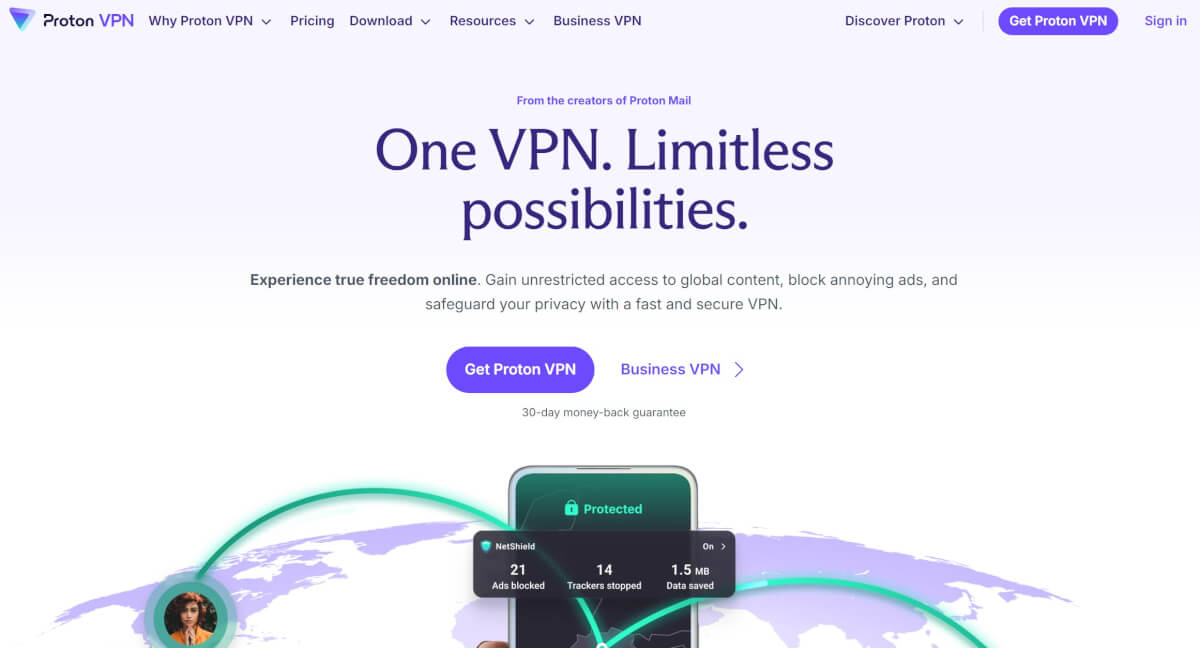
NetShield is a DNS filtering feature that blocks ads, trackers, and malicious domains at the network level — no browser extension needed. It works on all devices including mobile, and is available on paid plans.
Kill Switch and DNS Leak Protection
The Kill Switch automatically cuts your internet connection if the VPN tunnel drops — ensuring your real IP is never exposed. This feature is available even on the free plan. Proton VPN also actively prevents DNS leaks.
Tor over VPN
Select Proton VPN servers allow you to route traffic through the Tor network — without installing the Tor Browser. Ideal for maximum anonymity, though it significantly reduces connection speed.
Split Tunneling
Split tunneling lets you route some apps through the VPN while others connect directly to the internet. Useful when you want to use Netflix through the VPN but access your online banking without it.
Server Network
The paid plan gives access to more than 15,000 servers in 120+ countries with speeds up to 10 Gbps. The free plan covers servers in 10 countries (5 new locations were added in winter 2025/2026). On the paid plan, you can connect up to 10 devices simultaneously.
Compatibility and Platforms
Proton VPN has native apps for Windows, macOS, Linux, Android, iOS, Android TV, Apple TV, and Fire Stick. Extensions for Chrome and Firefox are also available. For advanced Linux users, a full-featured CLI tool with WireGuard, Kill Switch, and NetShield support was released in 2025/2026.
Pros
After extended testing, here’s my overview of the strengths and weaknesses you’ll notice in practice:
- Open-source code with independent audits — a level of transparency most competitors lack
- Swiss jurisdiction outside surveillance alliances (5/9/14 Eyes)
- Exceptional free plan with no data limit, no ads, and full encryption
- Secure Core for double identity protection
- NetShield ad and malware blocker built directly into the VPN
- Full Proton ecosystem (mail, drive, password manager) available in one plan
- WireGuard, OpenVPN, and Tor over VPN support
- Full-featured Linux CLI tool
- 30-day money-back guarantee
Cons
- Paid plan is more expensive than some competitors (CyberGhost, Surfshark) at equivalent subscription lengths
- Secure Core noticeably reduces connection speed
- Free plan is limited to 1 device and does not support P2P/torrenting
- Some users in testing reported issues streaming Hulu
- VPN Accelerator did not show a consistent, measurable difference in my tests
My Experience and User Reviews
I tested Proton VPN on Windows, macOS, and Android. Installation went smoothly on all platforms, the interface is clean, and Quick Connect works reliably — typically connecting in under 3 seconds. On the paid plan, I achieved speeds with only minimal drop compared to a direct connection — speed loss generally stayed below 15–20% on European servers.
I tested streaming on Netflix, Disney+, and YouTube. The paid version worked reliably without issues. The free plan can stream too, but free server speeds can be unstable during peak hours — upload was sometimes up to 80% slower than the paid version, which is noticeable on video calls.
I deliberately tested Secure Core — speed visibly drops when using this feature (sometimes to 30–40% of normal speed), but it’s a trade-off that makes sense for maximum anonymity. NetShield works reliably, blocking ads and trackers effectively.
Reviews on Reddit and independent review sites paint an overwhelmingly positive picture: users appreciate the transparency, open-source approach, and trustworthiness of the Proton brand. Criticism tends to focus on price compared to Surfshark or CyberGhost — but those who pay for Proton Unlimited appreciate getting mail, drive, and a password manager in the same package.
Alternatives
Proton VPN isn’t for everyone — here are alternatives I’ve personally tested and can specifically recommend.
Surfshark — Best Value for Features
Surfshark is currently one of the most competitively priced premium VPNs on the market — with a long-term plan, it comes in significantly cheaper than Proton VPN Plus. Surfshark allows unlimited simultaneous devices (Proton VPN Plus is limited to 10) and also includes an ad blocker (CleanWeb). The downside: Surfshark is based in the Netherlands (EU member, part of 9 Eyes), which is a weaker jurisdictional position compared to Proton. For everyday users, however, it’s an excellent choice at a lower price point.
CyberGhost — Largest Server Network
CyberGhost boasts an enormous network — over 11,000 servers in ~100 countries. It offers specially optimized servers for streaming and torrenting, which is handy when targeting a specific Netflix region. Long-term plans are cheaper than Proton VPN, and the money-back guarantee extends to 45 days. The jurisdiction (Romania, subsidiary of Kape Technologies) is controversial for some users.
hide.me — Great Free Plan With More Devices
hide.me offers one of the best free plans on the market — 10 GB of data per month at no cost and access to servers in 5 locations. The paid version supports 10 devices and a zero-log policy. If you’re looking for an alternative focused on simplicity and transparency, hide.me is worth considering — though it doesn’t match the breadth of the Proton ecosystem.
PrivadoVPN — Cheapest Long-Term Plan
PrivadoVPN is an interesting option for those focused primarily on price — the 2-year plan is among the cheapest in the market. It offers unlimited data, 10 devices, and a kill switch. On the other hand, PrivadoVPN does not publish its total server count and provides no open-source code, which is a significant transparency gap compared to Proton VPN.
Summary and Rating
I rate Proton VPN 9/10. This is the VPN I recommend above all to those who treat privacy as a genuine priority — not just a marketing slogan. The open-source code, independent audits, Swiss jurisdiction, and Secure Core make Proton VPN one of the most transparent tools on the market. The Proton Unlimited plan is outstanding value if you also use the mail, drive, and password manager.
I recommend Proton VPN if: you care about real privacy and transparency, you want a no-compromise free VPN, you’re considering the full Proton ecosystem, you need a VPN for Linux with CLI support, or you travel to countries with internet censorship.
I don’t recommend Proton VPN if: you’re primarily looking for the lowest price (check Surfshark or CyberGhost), you need unlimited devices, or Secure Core’s speed reduction is unacceptable for your use case and you don’t need double protection.
Frequently Asked Questions
Is Proton VPN really free?
Yes, Proton VPN Free is genuinely free — no data cap, no ads, and full encryption. You’re limited to 1 device and servers in 10 countries (free locations). Streaming and P2P are only partially supported on the free plan.
Does Proton VPN keep logs?
No. Proton VPN has a strict no-logs policy — it does not record your activity, IP address, or visited websites. This claim is verified by independent security audits and confirmed by real-world cases where Proton was unable to provide logs to law enforcement.
Does Proton VPN work with Netflix?
Yes, the paid plan (VPN Plus and Unlimited) reliably works with Netflix, Disney+, Amazon Prime Video, and other streaming services. The free plan doesn’t exclude streaming but doesn’t guarantee it — I recommend using the paid version for a consistent experience.
How many devices can I connect with Proton VPN?
Free plan: 1 device. VPN Plus and Proton Unlimited: up to 10 devices simultaneously. If you need more, Surfshark offers unlimited devices.
What is Secure Core and when should I use it?
Secure Core is a double VPN feature — your traffic passes first through a server in a privacy-friendly country (Switzerland, Iceland, Sweden) and then through an exit server. I recommend it when travelling to countries with censorship or when working with sensitive data. Expect a significant speed reduction.
Is Proton VPN legal?
Yes, using a VPN is fully legal in most countries, including the US, UK, and across Europe. A VPN does not authorise unlawful activities — it simply protects your privacy from ISPs, ad networks, and other third parties.
Does Proton VPN offer a money-back guarantee?
Yes, Proton VPN offers a 30-day money-back guarantee — note that it’s a pro-rated refund (you receive the value of unused days, not the full amount). The free plan can be tried without any risk and without entering a payment card.